Use Cases

You have been putting off the conversation for a week now. Someone on your team keeps missing a step in the handoff. A patient is going to ask the question you have not rehearsed. A supervisor needs to be told the decision was wrong, without the whole thing turning into an argument.
You know the policy. You have read the guidance twice. None of that is the problem. The problem is the other person, and the fact that you have no idea what they are going to say.
That gap is what a AI roleplay training platform is for. It lets someone practise a real conversation inside a defined scenario, with another character answering back in role, and gives them feedback afterwards. The newer versions of this generate the character's responses from a role, live context and approved source material, instead of walking down a branch someone wrote in advance. Which means the learner can ask something nobody anticipated, and still get a sensible answer.
Whether that works is a fair question, and there is now enough published research to answer it more honestly than most vendor pages do. So this piece leans on the papers, including the ones that make the case for AI roleplay look weaker than we would like.
Watch our full presentation below to learn how conversational AI augments hard skills and soft skills training:
A policy document tells you which steps matter. It cannot reproduce the silence after a hard question, the pressure of answering with incomplete information, or the pull towards a safe script when the real answer is uncomfortable.
Practice does something a document cannot. It forces retrieval. The learner has to find the right idea in memory, put it into words that fit the moment, watch what comes back, and adjust. Anders Ericsson built his account of deliberate practice on exactly that loop: attempt, feedback, attempt again at the same skill. Hermann Ebbinghaus supplied the other half of the argument, which is that newly learned material fades fast without reinforcement. Between them they explain why a single well-designed training session so rarely survives contact with the job.
There is evidence for the specific case. MPathic-VR, a mixed methods study of 206 medical students across three US medical schools, found the intervention group outscored controls on a communication OSCE after practising with a virtual human, 0.806 against 0.752, with a P value of .01. The SOPHIE study took a similar approach with an AI standardised patient and reported improvement across three serious-illness communication domains the authors label Empathize, Be Explicit and Empower.
Different systems, different populations, different outcome measures. Put together they do not prove that AI roleplay works in general, and anyone telling you otherwise is selling something. What they do show is that rehearsal keeps earning its place as a training mechanism, and that a simulated conversation partner can carry it.
The feedback half matters as much as the practice half. A rubric the learner can see, a clear account of where the conversation went sideways, and a chance to run it again while the memory is still warm. Get those three things right and the loop closes. Get them wrong and you have built an expensive chatbot.
Branching scenarios work well when the designer can predict which paths matter. Compliance checks, procedural sequences, anything with a known correct route through it. Those are still the right tool, and nothing here argues otherwise.
They get brittle when the skill itself is conversation. A manager on the receiving end of feedback might acknowledge the concern, or challenge the premise, or change the subject, or ask what evidence you have, or just go quiet. A patient will ask the same question in a form the scriptwriter never considered. You can keep adding branches, but every branch is more authoring work and it still only covers answers somebody thought of first.
The CommCoach researchers interviewed managers about how they would want to use AI for communication practice, and the answers are worth reading. Participants valued adaptive, low-risk simulation for difficult workplace conversations. They also asked for human and AI working together, feedback that understands context, and more control over the persona they were practising against. The authors are careful about the tensions in their own design, naming realism against bias, and open-ended conversation against the structure a workplace actually has. That reads like an honest description of the problem rather than a verdict against scripted content.
The practical difference is repetition. A scripted scenario costs almost nothing to run again, but it never changes. A human actor or a peer changes every time, and reads the room, but needs another person's diary for every attempt. Generated roleplay sits between the two: it varies, it is available at eleven at night, and it costs nothing per additional run. That is the whole pitch, and it is narrower than it sounds.

The authoring unit changes. Instead of writing the next line, a training team defines who the character is, what it is allowed to know, what role the learner is playing, and where the boundaries sit.
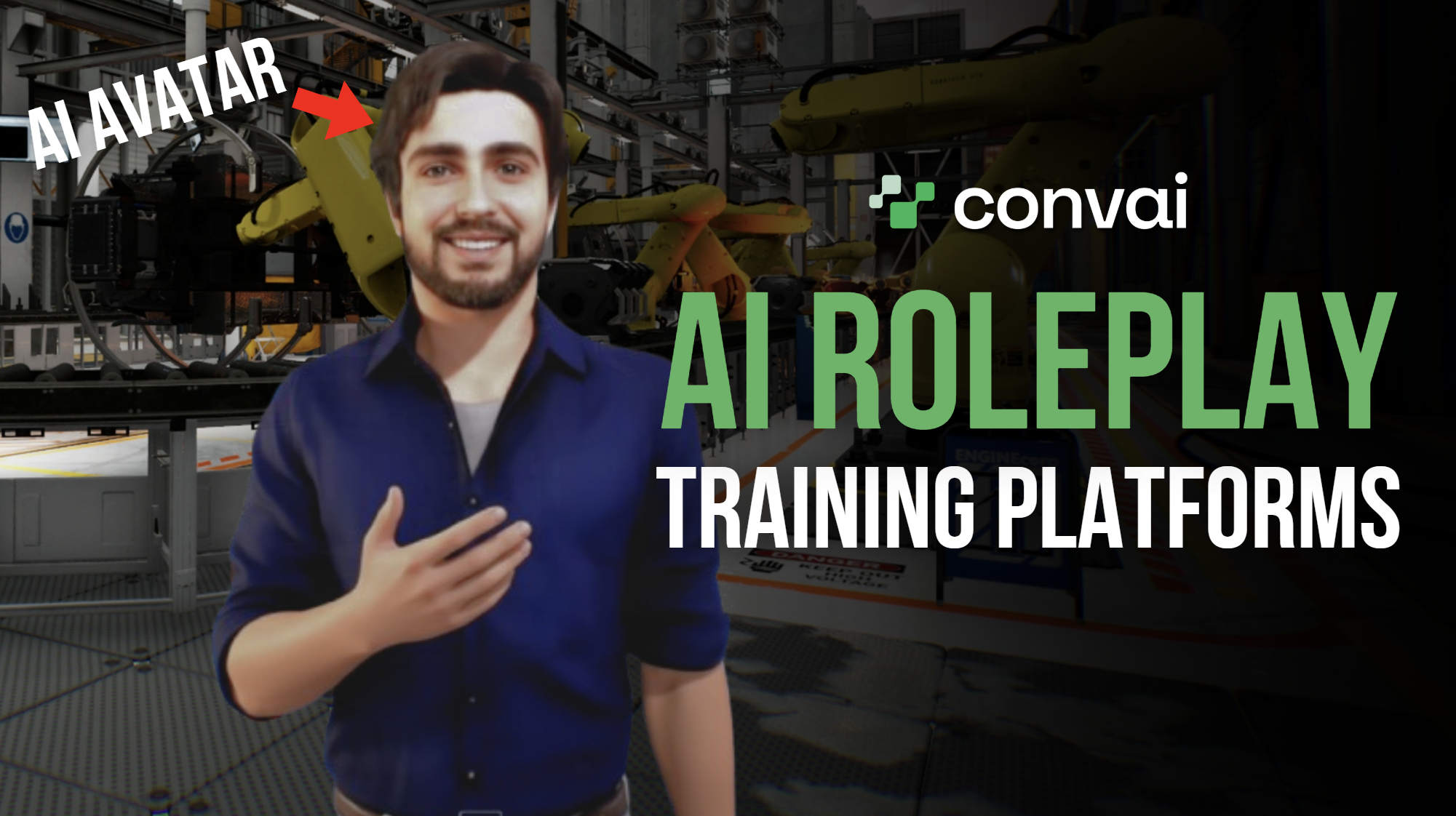
Convai's documentation describes one core agent that can surface through voice, text, an avatar or a spatial environment. A team can put it in the browser through Avatar Studio, drop it into an interactive 3D scene through Convai Sim, or shape behaviour and permitted actions through character customisation.
What the learner gets from that is permission to go off script. What the training team keeps is the task, the guardrails and the criteria. The pattern travels reasonably well across clinical conversations, industrial handoffs, support de-escalation, onboarding and sales practice, because in all of those the hard part is the same: someone unpredictable is talking back at you.
Convai turns up in two peer-reviewed papers describing agents that were actually deployed, one clinical and one in a university VR environment. Both are small. Both are worth reading precisely because they say what they cannot show.
The first is a 2024 pilot in the Postgraduate Medical Journal, from Cambridge University Hospitals NHS Foundation Trust, which used Convai to build a virtual patient avatar for anaesthesia training. Fifteen anaesthetists were surveyed afterwards. They gave it a median 9 out of 10 for being intuitive and user-friendly, 8 out of 10 for accuracy, and 87% said they felt comfortable using it. The team uploaded custom content to cut down on invented answers. Their conclusion is unambiguous and worth quoting in any internal business case: further research and fine-tuning are required before generative conversational AI can act as a substitute for actors and peers.
The second describes TUMSphere, a VR orientation platform at the Technical University of Munich that wired large language models into Unreal Engine through Convai. Twenty-four international students took part. The authors reported a System Usability Scale score of 76.4, full task completion for navigation and 96% for information retrieval, and a significant drop in reported social anxiety compared with the equivalent human interaction. That last finding is the interesting one, and it points at a use case that gets overlooked: sometimes the value of the AI is that it is not a person.
These two studies should not be added together. Different populations, different outcomes, different questions. What they are useful for is narrower and more honest than a headline number. Both document a real deployment with stated methods, sample sizes and limits, which is more than most of this category can offer. Convai also appears in the community-maintained Awesome LLM Patient Simulators index by way of the Cambridge paper.
Then there is the study that sets the ceiling. A pilot randomised controlled trial in BMC Medical Education put AI chatbot simulation against peer roleplay for OSCE preparation with 19 final-year Korean medicine students. Nothing reached statistical significance, and the patterns ran both ways. The peer group tended to score higher on history taking and rated the realism of the exchange more highly. The AI group did better on patient education and preferred the autonomy, the repetition and the structured feedback. The authors recommend blending the two.
That is the state of the evidence. AI roleplay matched peer roleplay in the one head-to-head trial available. It did not beat it.
Generated roleplay loses the room the moment a character invents a policy, a dosage or a procedure. Grounding is the mitigation: give the agent approved material and keep it there.
Convai's Knowledge Bank is that layer, and it is worth checking the supported formats before anyone plans a content migration. The documentation describes text and CSV in RAG mode, and text, CSV, images, PDF, audio and video in in-context mode depending on which model you have selected. Office formats such as .docx and .pptx are not supported directly and have to be converted first. If your standard operating procedures live in PowerPoint, that is a real piece of work to budget for, not a footnote. The Cambridge team used this same layer to reduce false information in their virtual patient's answers.
None of this makes hallucination impossible. What it buys you is a content boundary you can point at, and a way to update approved knowledge without rewriting a conversation tree. Review, version control and a regression check when procedures change all stay with the training team, exactly as they would with any other content system.
Training already happens in too many places. A browser portal for compliance, a headset application for the plant, a Unity or Unreal project someone built two years ago, tablets on the floor, and at least one internal tool nobody wants to touch. Rebuilding the same scenario in each of those is where roleplay programmes usually die.
A portable agent avoids that. Convai documents integration paths for Unity, Unreal Engine and the Web SDK, with further paths under other integrations. Browser experiences run on laptops, phones and tablets, which covers most learners most of the time. XR deployments need a dedicated application built in Unity or Unreal. Cloud and on-premises options exist for organisations whose security team will ask.
Convai's product materials specify support for 65 languages and more, which is what makes multilingual roleplay training viable without maintaining a separate scenario per region. Worth separating two things there, though: whether the platform speaks a language, and whether your training is valid in it. Terminology, cultural expectations around directness, and the scoring rubric itself all need a local review before anyone is assessed in that language.
A roleplay training platform ends up holding learning records, conversation transcripts and your internal procedures. Treat the AI layer like any other system with that data in it.
Convai states on its main site that it is ISO 27001 compliant, and its enterprise materials describe SOC 2 aligned controls. Ask for the certificate scope and the current report rather than taking the label, the same as you would with any vendor. The Enterprise page covers the rest: control over how input and output data is retained, accessed or deleted, and isolated cloud, private or on-premises deployment, with the final scope written into the agreement.
Two questions the public materials do not settle are SCORM export and direct LMS integration. If your programme depends on either, get the integration path confirmed before you scope a pilot rather than discovering it in week three.
The honest answer is: in most of the places that matter for assessment.
A model scores against a rubric, and the rubric will miss what a good coach notices in the first thirty seconds. A manager knows the history between two people and what is really at stake in a phrase. A facilitator can stop a session when a learner is diligently rehearsing the wrong pattern, which is worse than no practice at all. An actor can generate genuine social pressure when that pressure is the point of the exercise.
Transfer is the other thing nobody measures often enough. Someone can get very good inside a simulation and still come apart in the real conversation, where consequence, fatigue, status and organisational history all show up uninvited. If you buy one of these, measure behaviour after the practice, not the score inside it.
Which leaves a reasonable place to land. Use AI roleplay where repetition, access and variation are the constraint, which is most of the volume in most training programmes. Keep people in the loop for judgment, relationship context and anything high stakes. A browser rehearsal is a good way to arrive prepared for live coaching. A virtual patient is a good way to arrive prepared for the actor. The only head-to-head trial we have points at a blend, and that is probably the right answer for now.
A roleplay training platform lets learners practise conversations or decisions inside a defined scenario and receive feedback against a rubric. An AI roleplay training system generates the other character's responses from a role, live context and approved knowledge, which allows far more conversational variation than a fixed branching script can cover.
Traditional roleplay gives learners human judgment, social nuance and relationship context, but it needs another person's time for every session. AI roleplay makes repeated practice easier to schedule and varies the conversation across attempts. It works well as a rehearsal layer, while actors, peers and facilitators stay valuable when the goal depends on human judgment or a specific interpersonal dynamic.
No. A pilot randomised controlled trial in BMC Medical Education found AI simulation produced OSCE performance comparable to peer roleplay across 19 students, not better, and the Cambridge authors state that generative conversational AI is not yet a substitute for actors and peers. AI expands access to rehearsal, while coaches and facilitators remain stronger for judgment and high-stakes assessment.
Yes, when the platform offers a governed knowledge layer. Convai's Knowledge Bank connects character responses to approved material, and the Cambridge pilot describes custom content used to reduce false information. Check the current supported file formats before planning a migration, and keep content review, version control and testing in place, because grounding reduces risk rather than removing it.
Convai's product materials specify support for 65 languages and more for conversational characters, which lets one agent architecture serve multilingual roleplay training across regions. Language availability and training validity are separate questions, so review translations, terminology, cultural expectations and scoring rubrics for each market before you run assessments in that language.
A headset is optional. Convai documents browser experiences through its Web SDK for laptops, phones and tablets, while XR deployments use dedicated applications built in Unity or Unreal Engine. Choose the interface that fits the skill, the environment and the hardware learners actually have, because the same underlying character can run in more than one of them.
Convai states that it is ISO 27001 compliant, and its enterprise materials describe SOC 2 aligned controls and client control over how input and output data is retained, accessed or deleted. Isolated cloud, private and on-premises deployment options are defined per agreement. Ask for current certificate scope and reports, then map them to your retention, access and compliance requirements.
If you are working out whether a roleplay training platform fits your programme, the useful next step is not a demo. Take one conversation your people genuinely avoid, and map it end to end: who the character is, what it may know, what good looks like, and how you would tell whether anything changed afterwards. Convai's documentation and experience page are the place to start, the blog has deployment write-ups, and the Enterprise page is where the security conversation begins.


