Use Cases

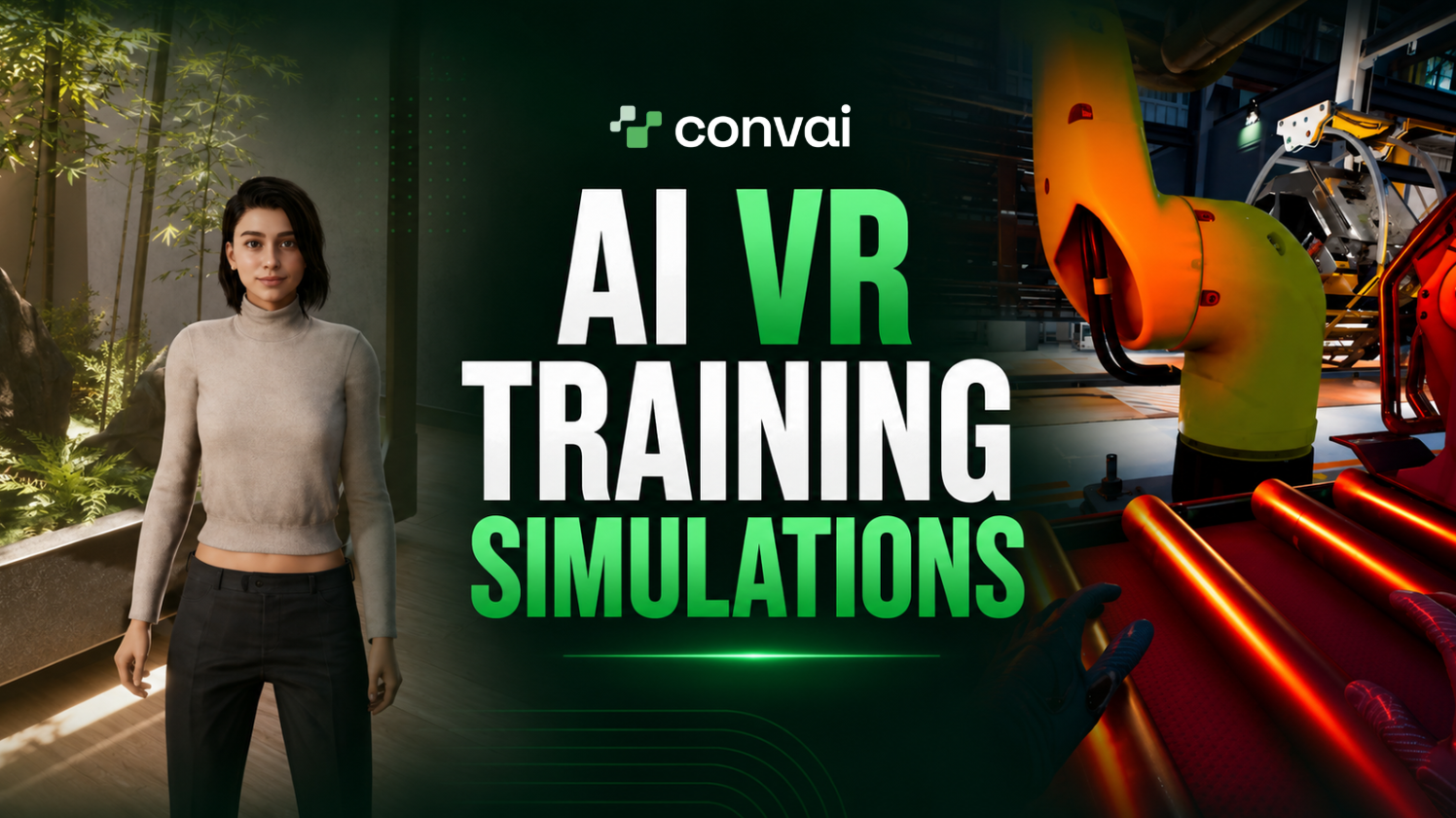
A trainee stands inside a headset, facing a virtual instructor beside a machine. Halfway through the exercise she asks a question the scenario writer never anticipated: "What should I check before I restart the line?" The character pauses. No branch exists. The scene offers the same three choices written months ago, and the most useful moment in the lesson disappears.
That gap is the problem worth solving. In its enterprise soft-skills study, PwC found that VR learners completed training up to four times faster than classroom learners and were up to 275% more confident about applying what they learned. PwC's UK team recorded a 40% confidence improvement over classroom instruction and 35% over e-learning in the same research. Immersion creates the conditions for practice. Conversational AI lets the practice respond when the learner leaves the script.

Immersion works because the learner's attention sits inside the situation rather than beside it. A headset blocks the room, fixes the task at human scale, and ties information to a place, an object, and an action. Those spatial and social cues give the practice a physical structure that a slide deck cannot reproduce.
That structure changes the learner's response. A difficult conversation creates tension. A safety drill creates urgency. The learner has to act while those feelings are present, then review what happened. PwC reported that VR learners felt 3.75 times more emotionally connected to the content than classroom learners. The value comes from that rehearsal loop: notice, speak, act, receive feedback, try again.
The effect shows up in controlled clinical studies too. A two-year randomised crossover trial with medical professionals in catheterization labs and orthopaedic theatres found immersive VR radiation-safety training produced measurably lower radiation exposure than traditional didactic training, with higher satisfaction and confidence. That is a physical outcome rather than a self-reported one.
Presence alone does not create a good lesson. The scenario still needs clear objectives, accurate procedures, feedback, and a way to measure performance. AI becomes useful when it preserves the sense of presence while letting the virtual instructor respond to language and behaviour the author never prewrote.

Most enterprise VR training still runs on dialogue trees, fixed prompts, and predefined outcomes. That works when a task has a small number of valid paths. It breaks down when a learner asks a follow-up question, uses different wording, skips a step, or needs an explanation tied to the object in front of them.
The maintenance burden grows with every branch. A policy change can affect dialogue, voiceover, subtitles, scoring, and scene logic at once. Teams reopen the project, trace the affected branches, record new lines, test each path, and redistribute the build. Meanwhile the floor is running the old procedure in the headset.
Published cost guidance from XR development studios puts LLM-driven NPC integration somewhere between $25,000 and $75,000 per project once prompt safety, latency tuning, and guardrails are included, and suggests procedural generation can cut authoring cost by 30% to 60%. Those are vendor estimates rather than market rates, so treat them as directional. They still show where the budget moves: away from writing every possible line, toward integration, evaluation, and content governance.

Most vendors solve this by selling AI as a feature inside their own platform. One ships scripted virtual humans. Another ships a library of pre-built modules. A third staffs a production team that builds your content for you. In each case the conversational layer belongs to the platform, and the platform owns the content, the deployment target, and the update cycle.
The market is consolidating in that direction. Established immersive-learning products are being folded into larger talent suites, which narrows the number of independent options a buyer can choose from and ties the AI layer more tightly to one vendor's roadmap.
That matters if you have already built on Unity, Unreal Engine, or a digital-twin environment. The engines are where enterprise simulation content actually lives. A conversational layer that plugs into the engine you already use is a different proposition from a platform that asks you to rebuild inside it.
An AI NPC can accept open-ended speech, retrieve approved information, read the current scene state, and generate a response that fits the question. In a workforce training simulation the character might explain why a step matters, ask the learner to inspect a tagged component, adapt a role-play, or trigger an approved in-scene action.
Embodiment adds signals beyond words. A 2025 CSCW study compared a text-only conversational agent against a VR-embodied one for interpersonal-skills training. Participants preferred the embodied experience and responded to facial expression, gesture, and tone, though the study found no statistically significant difference in learning gains between the two conditions. That distinction is worth keeping. Embodiment improves conversational dynamics and engagement. It does not remove the need for instructional design or outcome measurement.
Researchers have been building in this direction across domains. VAPS, a GPT-4o-powered virtual patient simulator, uses embodied conversational agents to train clinical communication in VR. A separate OzCHI paper examines using large language models to give embodied agents distinct personalities, and a 2026 narrative review covering studies from 2005 to 2024 found AI-augmented VR simulations improved procedural skills and critical thinking among healthcare students. The pattern holds across teacher training too, where a pedagogical framework paper argues AI-powered avatars let trainees accumulate far more practice hours than field placements allow.
The strongest public evidence for this model comes from a 2026 peer-reviewed paper in Frontiers in Computer Science on TUMSphere, a VR orientation platform for international students at the Technical University of Munich. The researchers connected large language models to Unreal Engine through Convai. Their embodied NPCs used speech recognition, context-aware dialogue, a knowledge base, and autonomous spatial navigation.
The mixed-methods study involved 24 participants. The authors reported a System Usability Scale score of 76.4, 100% completion for spatial navigation tasks, and 96% success for information retrieval. Complex, retrieval-heavy answers averaged 2.90 seconds from the end of the user's speech to audio response. Participants reported a statistically significant reduction in social anxiety, and 75% described the NPC as a low-pressure setting for language and administrative questions.
The limits are as useful as the results. German-language practice succeeded for 83% of participants, with failures traced to accent and hesitation in speech recognition. Forty percent felt unsure whether the system had heard them during the two-to-three-second silence while it processed their question.
This is one study with 24 participants, not proof of a universal training effect. It remains rare, independent evidence that an embodied AI agent can run inside a working Unreal Engine deployment while external researchers measure usability, latency, task completion, and learner experience.
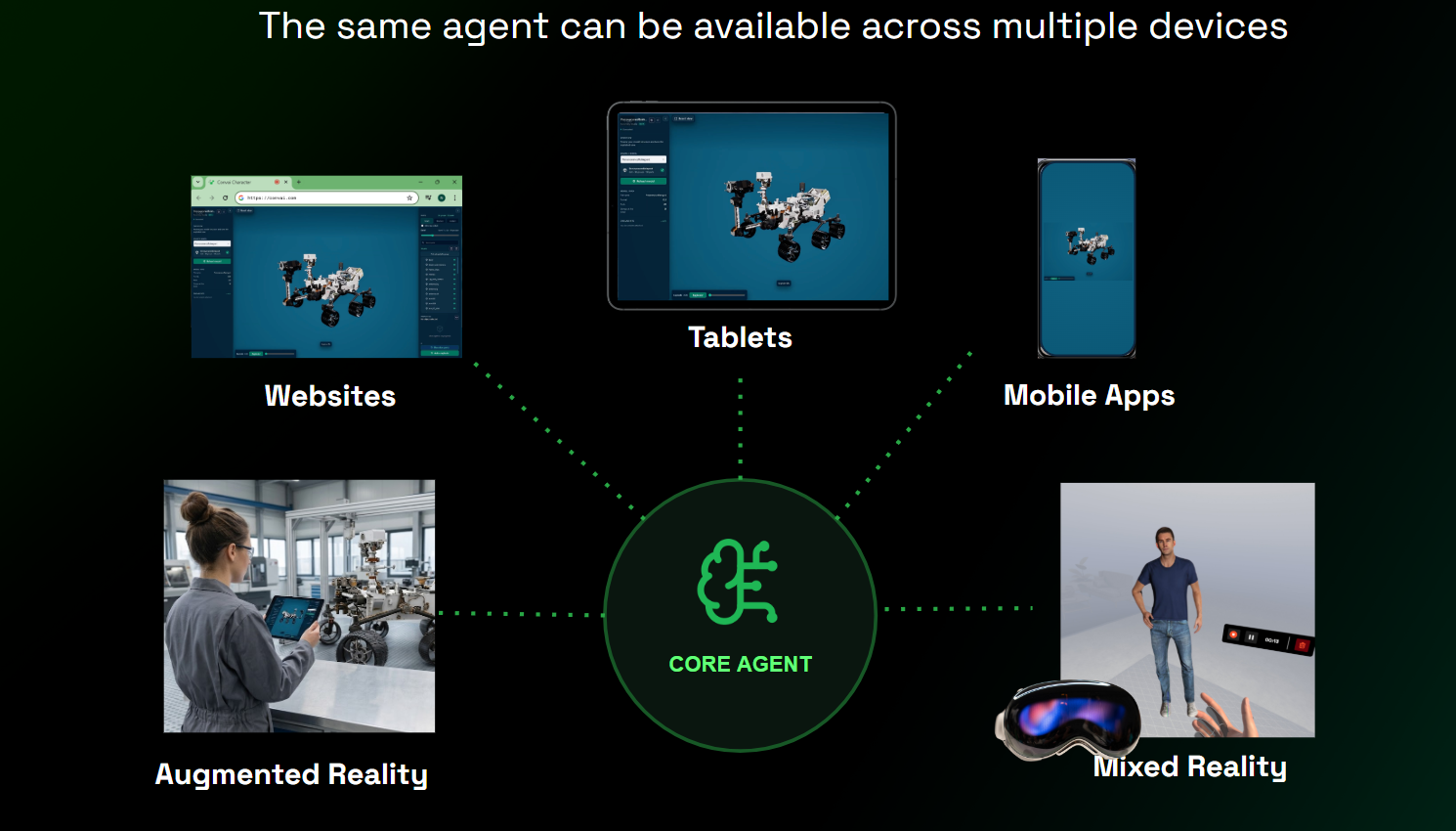
Training needs change by task. A headset earns its cost when the learner has to judge distance, coordinate movement, or rehearse a social exchange under pressure. A browser suits short refreshers and remote onboarding. A tablet or camera view fits a technician standing beside the physical equipment.
Convai runs one core agent across those surfaces. Native plugins connect it to Unity and Unreal Engine, with platform guides covering WebGL, Android, iOS, and Meta Quest deployment. The Web SDK handles browser delivery through Three.js and React, including hands-free voice without push-to-talk. Convai Sim provides a browser-based 3D environment with no installation, and Avatar Studio presents the same agent as a character with vision-based input, built entirely in the browser. Published examples run at x.convai.com. XR still needs a dedicated application because of deeper hardware integration.
Teams keep the agent's role, approved knowledge, and data connections consistent while changing the interface. A learner can practise a procedure in VR, review it in a browser, and get camera-based guidance at the worksite without a separate conversational system behind each one.
A shared knowledge layer moves approved information into a source the agent retrieves at runtime. Convai's Knowledge Bank holds text and multimodal assets, including PDFs, images, audio, and video in supported in-context modes. Technical materials, CAD and 3D assemblies, tagged scene objects, and camera input can all feed the same agent, and enterprise teams can manage files programmatically through the Knowledge Bank API.
A procedure change is then made once in the connected source rather than rewritten across every conversation branch. Connected deployments pick up the revision after testing and approval.
Research points the same way. The Text2VR prototype uses an LLM to extract task information from text and generate animated VR assembly instructions in Unity, demonstrated on a pneumatic-cylinder assembly. The authors had not run a user study, so it supports feasibility
What to Check Before You Choose an AI Layer
Start with independent deployment evidence. The TUMSphere paper matters because external researchers described the architecture, measured latency and usability, and published the failure modes alongside the results. Ask any vendor what independent evidence exists for their platform.
Then check where the AI can run. Convai ships native plugins for Unity, Unreal Engine, Three.js, and NVIDIA Omniverse, alongside browser and camera-based delivery, with support for over 65 languages. The Unity Asset Store lists Convai as a Verified Solution, and Convai reports more than 400 reviews across Unity, Unreal Engine, Three.js, and other virtual-world platforms. Teams evaluating the integration effort can read the Unity getting-started guide, the Unreal installation guide, or the open documentation repository before committing to a pilot.
Security and data control belong in the same conversation. Convai's information security management system is ISO/IEC 27001:2022 certified and its controls are SOC 2 compliant. Enterprise plans cover data ownership, isolated traffic, optional private or on-premise deployment, and service-level commitments. Convai's enterprise adoption is described at category level as trusted by Fortune 500 companies.
Business-case evidence needs context. A Forrester Total Economic Impact study commissioned by Meta reported 219% ROI, $4.2 million in net present value, and payback in under six months for a composite organisation built from interviews with decision-makers at four organisations. That supports the potential of enterprise VR at scale. It does not predict the return on any particular AI VR training simulation. Model your own content, integration, hardware, support, learner volume, and the ongoing cost of keeping procedures current.
AI-powered VR training combines an immersive 3D environment with a conversational AI agent that responds to what the learner says and does. Instead of choosing from prewritten dialogue options, the learner speaks naturally and the virtual instructor or role-play partner answers from an approved knowledge source. The AI can also read scene context and trigger permitted in-scene actions.
A scripted character follows a dialogue tree written in advance, so it can only handle questions the author anticipated. An AI NPC accepts open-ended speech, retrieves approved information at runtime, and generates a response that fits the learner's actual question. Updating a scripted character means re-authoring branches; updating an AI NPC means editing the connected knowledge source.
Yes. The same conversational agent can run in a browser, on a tablet, or through a camera view on a phone or laptop. Convai Sim provides a browser-based 3D environment with no installation, and Avatar Studio presents the agent as a character in a video-call-style interface. XR headsets need a dedicated application because of deeper hardware integration.
Yes. Convai ships native plugins for both engines, plus Three.js and NVIDIA Omniverse. Teams building custom training simulations in Unity or Unreal add the conversational layer to their existing project rather than rebuilding inside a closed platform. The Unity Asset Store lists Convai as a Verified Solution.
Published XR development guidance estimates $25,000 to $75,000 to integrate an LLM-driven NPC with prompt safety, latency tuning, and guardrails. That is a directional vendor estimate rather than a fixed market price. Real cost depends on the existing 3D environment, content depth, in-scene actions, integrations, security requirements, testing, device support, and rollout scale.
Convai acts as the conversational AI layer inside the training experience. It does not currently ship a native SCORM package or a built-in LMS connector. In practice the host application or enterprise training platform handles SCORM or xAPI reporting through a custom integration, so confirm the required data flow during solution design.
Convai's information security management system is ISO/IEC 27001:2022 certified and its controls are SOC 2 compliant. Enterprise plans cover data ownership and control, isolated traffic, optional private or on-premise deployment, and service commitments. Review current certificates, audit reports, retention terms, regional hosting, and contractual controls during procurement.
Talk to the Convai team about your training environment, the engine you build in, and the knowledge your agent needs to work from. If you would rather start hands-on, the documentation walks through creating and testing a character before you write any integration code.


